The Middle East hospitality sector is in the middle of an extraordinary expansion. Saudi Arabia's Vision 2030 programme has committed to more than 320,000 new hotel rooms by the end of the decade, with a stated goal of 150 million tourists annually. The UAE added over 50 major hotel openings in 2024 alone. Qatar, Kuwait, and Bahrain are following comparable growth trajectories.
For procurement managers and FF&E consultants working on these projects, wall art is no longer an afterthought. Guests arriving at a five-star Riyadh hotel, a luxury Corniche residence in Abu Dhabi, or a boutique riad in AlUla expect spaces that reflect the region's cultural identity — not generic abstract prints sourced from a catalogue designed for the European market.
This guide covers what procurement teams, interior designers, and hospitality operators in the GCC region need to know when sourcing Islamic wall art for commercial and residential projects.
1. What makes Islamic wall art different from standard decorative art?
Islamic art follows a distinct visual language that has evolved over more than fourteen centuries. Several principles shape what is appropriate for Muslim spaces and what resonates with GCC hospitality guests:
Subject matter. Traditional Islamic art avoids the representation of living figures (humans and animals) in religious or formal contexts. Geometric patterns, botanical motifs, and above all calligraphy are the primary visual vocabularies. For hotel public spaces — lobbies, prayer rooms, corridors, and presidential suites — calligraphic pieces are the most universally appropriate choice.
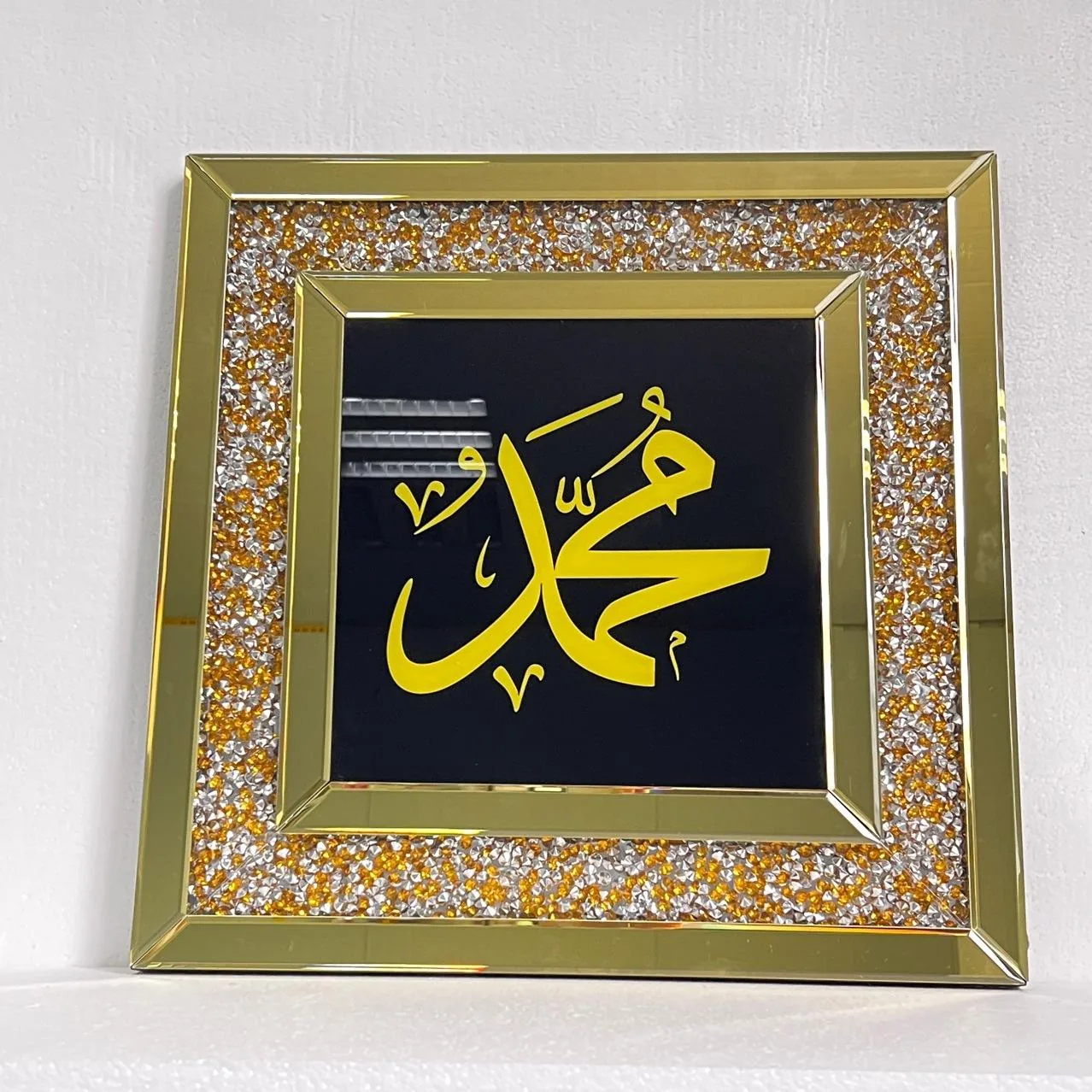
Calligraphic content. Quranic verses, the 99 names of Allah, the Shahada, and the names of the Prophet Muhammad (peace be upon him) are the most common subjects. These texts carry spiritual weight; the manner in which they are presented — the quality of the craftsmanship, the choice of materials, the size relative to the space — communicates respect or its absence.
Material and finish. GCC guests associate quality with specific material cues: gold and brass tones, crystal and glass, mirror etching, and intricate inlay work. Inexpensive printed posters or canvas prints of calligraphic text are immediately recognisable as budget choices. Pieces produced in high-quality glass micro-engraving, mirrored metalwork, or crystal-set frames carry the weight the content deserves.
2. What formats and substrates are available for Islamic calligraphy pieces?
At Qitong Arts, our Islamic wall art range covers four formats:
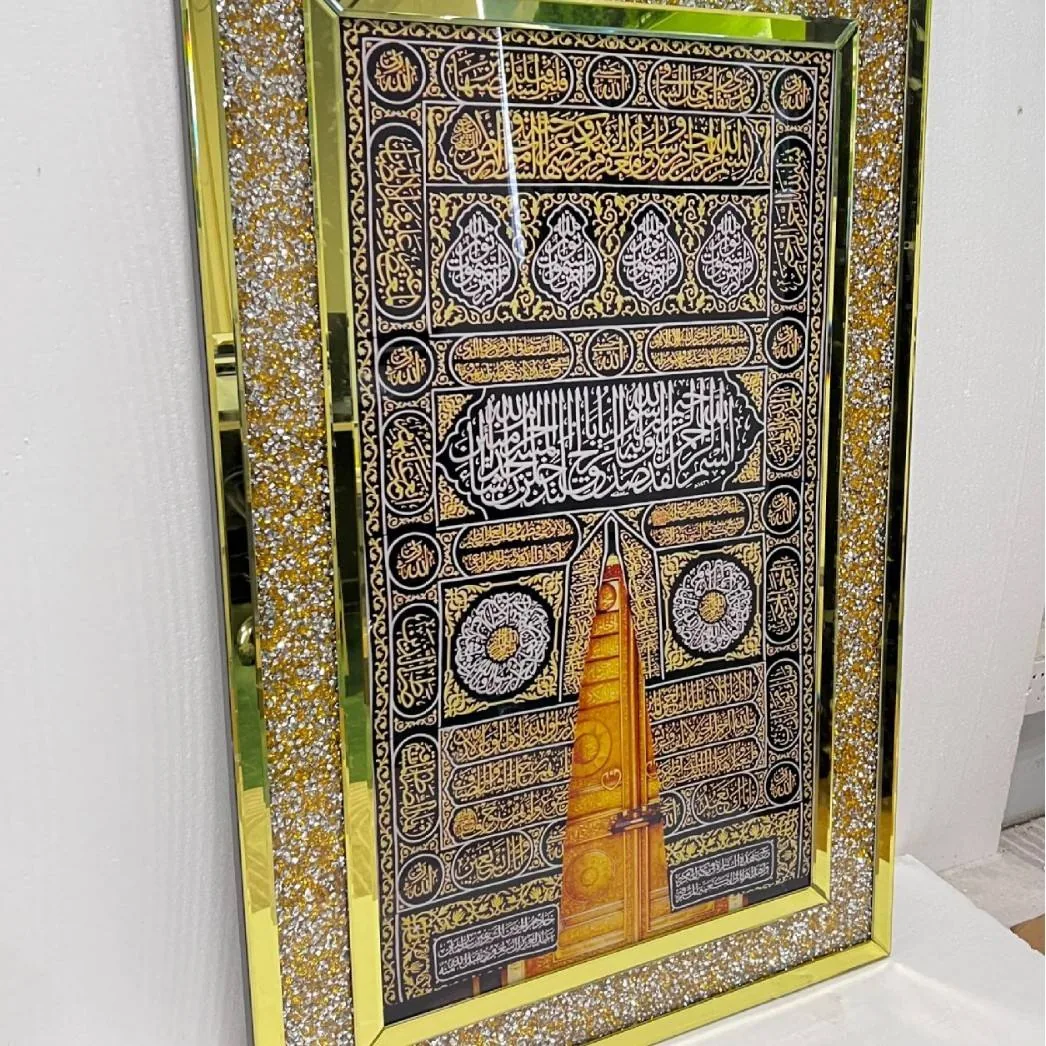
Glass micro-engraving with crystal inlay. Quranic text or architectural motifs (such as the Kaaba door) are engraved into high-clarity glass panels and set in gold or brushed brass frames with crystal or diamond-cut border detailing. This format is particularly suited to hotel lobbies, VIP suites, and formal reception areas.
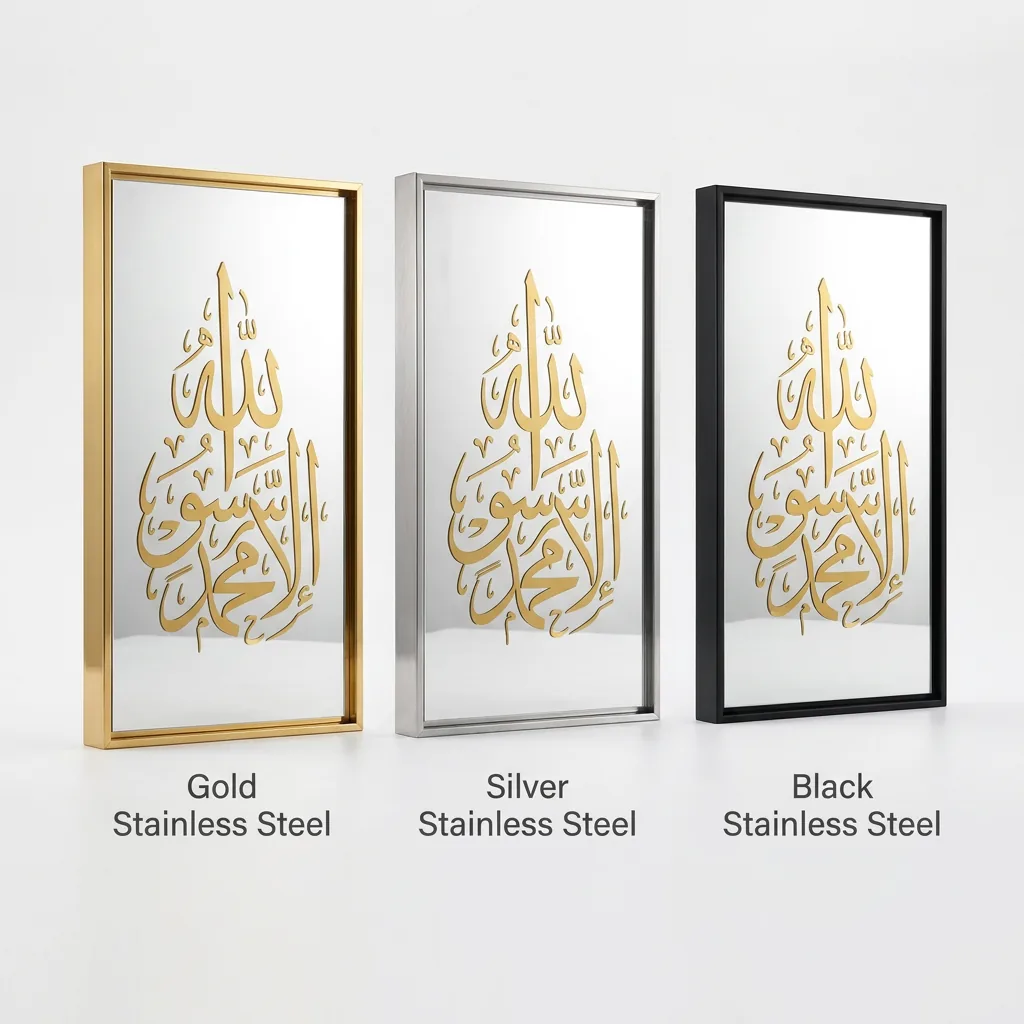
Islamic calligraphy mirror pieces. Laser-etched or handcrafted calligraphy on mirrored panels, framed in ornate metalwork. The mirror backing creates depth and light reflection appropriate for both residential and hotel settings. Available in single panels or triptych configurations.
Islamic world map and architectural panels. Decorative metalwork incorporating stylised maps of the Islamic world, mosque architectural elements, or geometric patterns. Suitable for corridors, boardrooms, and cultural institutions.
Giclée canvas and fine art prints. For projects selecting a lighter printed format, high-resolution giclée canvas prints of calligraphic compositions offer a defined visual treatment. Frame options can be reviewed in gold-tone, brushed brass, and matte black finishes, with the final specification confirmed by project scope.
All formats are available in custom sizes. We do not use animated or figurative imagery in Islamic pieces unless explicitly requested and approved by the client.
3. How do you ensure the calligraphic content is accurate and respectful?
This is the most important question procurement managers should ask any supplier.
Errors in Quranic text or in the spelling of sacred names are not merely aesthetic failures — they can cause significant offence and, in some jurisdictions, create serious problems for the property. We have seen this happen with pieces sourced from suppliers who treated Islamic calligraphy as purely a visual pattern.
Our production process for calligraphic content:
- All Quranic text is verified against authoritative printed sources before production. We work with Arabic-literate quality reviewers for all calligraphic content.
- The names of the Prophet Muhammad (peace be upon him) and the Shahada are treated as content requiring specific handling; we follow the conventions used by established Islamic art suppliers in the region.
- Clients who require independent verification of calligraphic accuracy can request a full-resolution digital proof for review by their own religious or cultural advisors before production begins. The proof scope, timing, and any applicable cost are confirmed in the project terms.
4. What is appropriate for hotel public spaces versus private suites?
The distinction matters for two reasons: the audience and the context of interaction.
Public spaces (lobby, corridor, restaurant, meeting rooms): Universally recognisable calligraphic subjects — the Bismillah, the 99 names, geometric compositions — are appropriate for all guests regardless of religion. Avoid highly specific religious content (such as complex Hadith quotations) that may be unfamiliar to non-Muslim international guests.
Prayer rooms and mosques: Full Quranic chapters (surahs), the Qibla direction marker, and pieces incorporating the names of Allah and the Prophet are standard. These pieces are produced with the understanding that they will be in a dedicated religious space.
Presidential and VIP suites: Select calligraphic content, scale, material, and finish against the approved interior and cultural brief. Final dimensions are confirmed by the installation plan.
Private residential projects: Client preferences vary significantly. Some clients prefer overtly religious content throughout; others prefer geometric or botanical interpretations of Islamic art that read as culturally resonant without explicit textual content. We produce both.
5. What compliance documentation do you provide for GCC shipments?
For shipments to Saudi Arabia, UAE, Qatar, Kuwait, and other GCC destinations, review the documents required for the specified materials and destination:
- Commercial invoice and packing list with the applicable product classification
- Origin documentation where required by the destination
- Phytosanitary or fumigation documentation where required for the specified wooden components and destination
- Material safety data sheet for frame adhesives and surface coatings
We do not make claims about specific religious certifications or halal compliance for decorative art pieces, as no standardised framework for this category exists across GCC markets. Buyers should confirm any specific documentation requirements for their destination country with their customs broker.
For Saudi Arabia, buyers should confirm current customs requirements for decorative arts and large-format pieces with their broker. Technical drawings and dimensions can be reviewed as part of the agreed project documentation scope.
6. What are typical lead times for a hotel project in the GCC?
Lead time is confirmed after the format mix, approved design, quantity, destination, and delivery responsibilities are reviewed. Share the installation window and any Ramadan-sensitive milestone in the project brief so the available schedule can be assessed before approval.
7. What minimum order quantities apply?
Minimum quantities and prototype options are confirmed by the format, design review, and project scope.
For hotel projects, mixed batches can combine subjects, sizes, and formats when the packaging, freight, and delivery scope are agreed. Quantities and design counts are confirmed in the project quotation.
8. How do you handle colour and finish consistency across a large order?
For glass and mirror pieces, consistency is managed at the material specification stage: we source glass, crystal, and metalwork components from the same batch for each project run, and finish specifications (gold tone, brushed brass, matte black) are matched to a physical reference sample approved by the buyer.
For giclée canvas prints, any colour measurement should be specified by the project brief, including the reference proof, method, sample scope, instrument, and acceptance threshold.
Pre-shipment photographs of every piece are taken in controlled lighting and shared with the buyer before dispatch. This is particularly important for Islamic calligraphy pieces where the buyer or their representative should verify the final presentation.
9. Can you work with a designer's custom calligraphic compositions?
Yes. If your project involves a commissioned calligrapher or a specific calligraphic style (Naskh, Thuluth, Diwani, Kufic), we can review the artist's digital file. File quality, usage rights, and production feasibility are confirmed for the chosen substrate.
For clients without an existing calligraphic design, our studio works with an approved set of classical compositions that have been verified for textual accuracy. We do not generate calligraphic designs using automated tools.
10. What does a complete project engagement look like?
A typical GCC hospitality project moves through the following stages:
Stage 1 — Scope definition. You share the project brief: property type, number of pieces, key spaces, overall interior direction (contemporary Islamic, classical, heritage), and timeline.
Stage 2 — Design proposal. We provide a set of recommended formats and compositions for review, with reference images from previous projects. Client revises and approves.
Stage 3 — Sample production. Sample quantity, size, finish, timing, and client or religious-advisor review are confirmed by the project brief.
Stage 4 — Production. Production follows the approved design and specification. Any colour review, inspection, and pre-shipment photography are confirmed by the project terms.
Stage 5 — Shipping. Freight handover, origin, packing, and destination documents are confirmed with the buyer's nominated forwarder and the project terms.
Why coordinate an Islamic wall art project with a specialist team?
Project coordination keeps substrate choice, size adjustment, finish modification, sample approval, documentation, and delivery responsibilities in one written workflow. Compare the full service scope for the project rather than assuming a fixed margin or route advantage.
Qitong Arts coordinates decorative and Islamic wall art projects through a documented project workflow. Destination, material, cultural review, and delivery responsibilities are confirmed by project scope.
We do not claim religious certifications that do not exist. Buyers should arrange cultural or religious review where required, and confirm that the agreed material, production, and delivery scope fits the installation timeline.
Contact and next steps
If you have a GCC hospitality or residential project where Islamic wall art procurement is on the specification list, we welcome a brief project discussion.
FAQ
Q1: How should Quranic calligraphy content be reviewed?
Use an authoritative reference and include a digital proof review by the buyer's religious or cultural advisor before production. The review responsibility and any proof scope should be confirmed in the project terms.
Q2: What formats of Islamic wall art can be reviewed?
Possible formats include glass micro-engraving, calligraphy mirror pieces, architectural panels, and giclée canvas. Final size, frame, finish, and availability are confirmed by project scope.
Q3: What compliance documents should buyers review for GCC shipments?
Review the commercial invoice, packing list, origin, material, and any phytosanitary or fumigation documents required for the specified materials and destination. Availability is confirmed by project scope.
Q4: What is the lead time for a GCC hotel Islamic wall art project?
Lead time and freight timing are confirmed after the format mix, approved design, quantity, destination, and delivery scope are reviewed.
Q5: Do you have minimum order quantities for Islamic wall art?
Minimum quantities and mixed-format options are confirmed by project scope, format, and production requirements.
Contact: sales@qitong-arts.com
Response time: at the earliest opportunity (Arabic-language enquiries welcome)
Project terms: specification, approvals, documentation, and delivery responsibilities confirmed by project scope
Project logistics: delivery responsibilities and handover arrangements are confirmed by project scope
Browse Middle East / Islamic Range → Commercial & Hospitality Projects →