Quick Answers
- What is the difference between hand-painted and Giclée? Hand-painted work carries physical brush or palette-knife variation; Giclée reproduces an approved image with a more repeatable visual surface.
- Can hand-painted pieces be consistent across hotel rooms? They can be coordinated through an approved design direction, sample, palette, frame, and review record without claiming that every piece will be identical.
- What must be approved? Subject, canvas, surface texture, frame, finished size, orientation, viewing distance, and the project handoff record.
Start with the quality the space actually needs
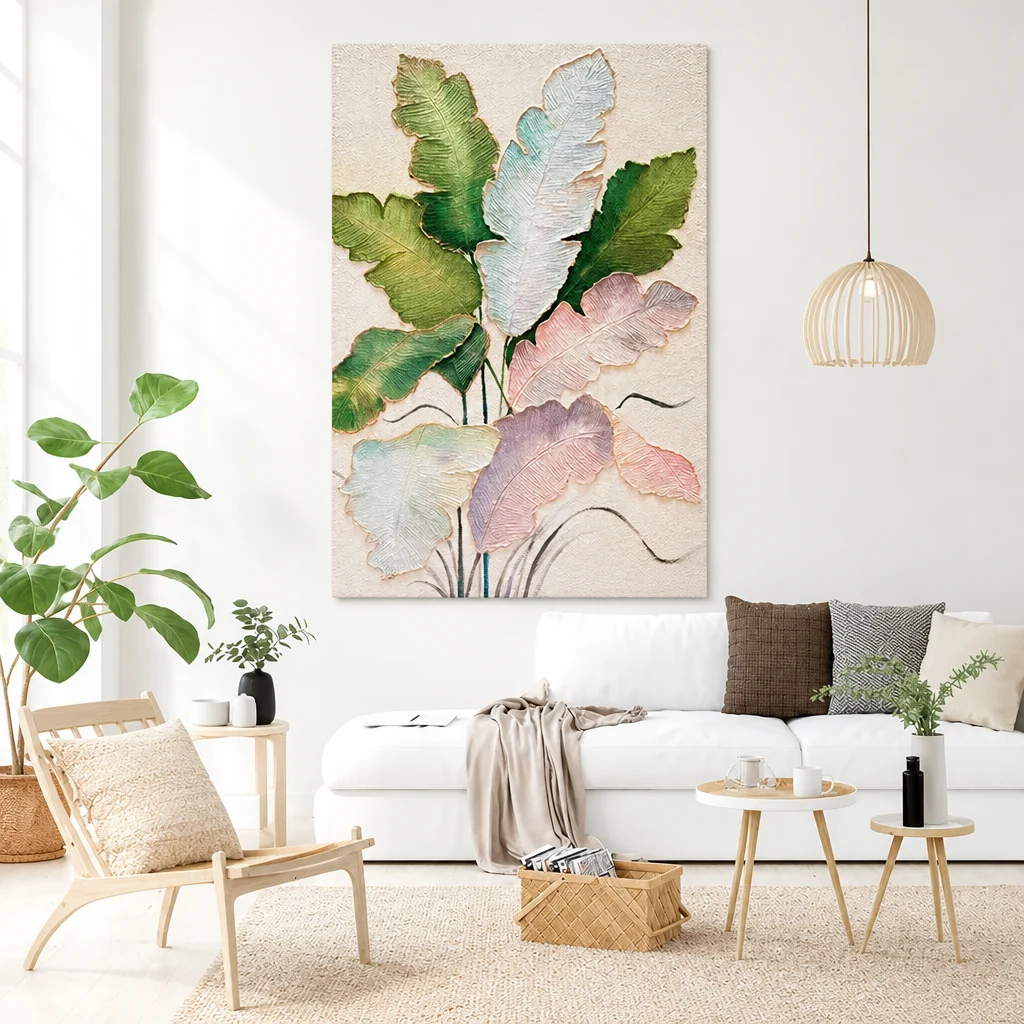
Hand-painted oil paintings are often selected for hospitality spaces because the surface has a physical presence. A brush stroke, palette-knife ridge, layered neutral, or raised botanical detail can read differently from a printed image when a guest passes close to the wall. That quality can be valuable in a suite, lounge, spa, restaurant, or reception area, but it needs to be specified clearly.
The first decision is not “oil or print” in isolation. It is the relationship between viewing distance, repetition, texture, subject, colour control, frame, maintenance context, and project schedule. A single feature piece may prioritise surface character. A repeated guest-room programme may prioritise a controlled visual system. Both can be valid; the brief should make the priority explicit.
1. Hand-painted oil versus Giclée reproduction
Giclée is a reproduction process: an approved image is printed onto a selected surface using a controlled colour workflow. It is considered when the same artwork needs to appear across multiple rooms, when a photographic or graphic reference must be reproduced, or when the project values repeatable placement and colour review. The finished piece can still have a frame, a gallery wrap, or a selected surface treatment, but the image itself is reproduced.
Hand-painted oil work is built through physical application. A painter may use brushes, palette knives, dry brushing, glazing, or layered relief to create the surface. The result is not a pixel-identical copy of a reference image. For procurement, the reference should therefore describe the subject, palette, composition, texture direction, frame, and intended visual relationship rather than promise identical brush marks across every piece.
Our existing Giclée vs Oil Painting for Hotels guide gives a broader format comparison. For a project decision, connect that comparison to the room schedule and the approval method rather than selecting a medium from a product title alone.
2. Describe the surface, not only the subject
“Abstract landscape” or “botanical painting” identifies the subject direction, but it does not tell a buyer how the surface should read. Add a texture field: flat, lightly layered, palette-knife, directional impasto, raised relief, or another project term that can be shown in a close-up reference. Note whether the texture is concentrated in a subject area, distributed across the canvas, or used as a restrained accent.
Viewing distance changes the decision. A relief that reads clearly at arm’s length may become a quiet tonal field across a lobby. A highly directional texture can create a strong highlight under a narrow picture light. A buyer should review a close-up, a normal viewing image, and a room-context image where possible. The purpose is not to overstate a finish; it is to ensure that the words, photograph, and intended viewing distance describe the same object.
3. Canvas, stretcher, edge, and frame
Specify the completed assembly, not just the painting surface. The canvas, stretcher, edge treatment, frame, hanging orientation, and finished dimensions all affect how the piece sits on the wall. A wrapped canvas can present a continuous image over the edge, while a framed canvas creates a separate visual boundary. A metal frame may sharpen a contemporary direction; a timber or floating frame may shift the visual weight.
For a hospitality schedule, record whether the dimensions include the frame, how portrait and landscape orientation are determined, whether the artwork is delivered ready to hang, and whether the frame selection is the same across the room set. If a room photograph is used to show scale, treat it as a context reference only. It does not replace the finished dimension and frame fields in the specification.
4. Batch consistency without pretending that paintings are identical
A coherent hotel programme can use several related paintings without requiring every surface to be identical. Start with a visual system: subject family, palette, contrast, texture level, orientation, frame, and location. Then choose a representative sample or proof that demonstrates how the system should read. The review record should identify what is fixed and what may vary.
Useful fixed fields include the dominant palette, frame colour, canvas orientation, subject category, approximate texture direction, and room placement. Useful variable fields include individual brush movement, small colour transitions, and the exact distribution of relief. This approach respects the medium while giving the design and procurement teams a practical reference.
For large room programmes, a colour review can compare the approved reference, sample, and finished photo set. The colour review guide explains why a measurement method, reference proof, sample scope, and acceptance responsibility should be agreed when formal colour documentation is required. Hand-painted pieces require a different review logic from a repeatable print, so the record should say which method applies.
5. Sample and approval workflow
A sample request works best when it is specific. Include the subject, canvas, frame, intended finished size, texture direction, palette reference, viewing distance, and the room or wall context. Ask how comments will be recorded, who owns revisions, and what event moves the project from sample review to production scope. Avoid vague approvals such as “looks close” when the project has a defined design intent.
The project record can contain the brief, selected artwork reference, sample images, comments, revision notes, approved frame, finished dimensions, and handoff photographs. It can also record open questions for the buyer, such as final wall access, installation responsibility, or a change in room type. The record is valuable because it preserves the decision, not because it makes an artistic medium behave like a machine process.
6. Common specification mistakes
- Calling a printed image “hand-painted” because the artwork has a textured appearance.
- Describing a close-up texture photograph as the finished size or overall composition.
- Using a room mock-up to infer the frame, wall fixing, or finished dimensions.
- Requesting identical brush marks across a hand-painted batch without defining what “consistent” means.
- Changing the subject, palette, or frame after sample approval without updating the project record.
- Using a lighting accessory or room fixture as if it were part of the painting specification.
For the complete collection and current project fields, visit the hand-painted oil paintings project page. For a broader procurement framework, review the custom wall art specification guide.
Planning a Hospitality Art Programme?
Send the room schedule, subject direction, palette, texture preference, frame, and approval requirements for a project-based review.
Start a Project Enquiry →